Guide
Baby-Led Weaning Starter Guide 2026: First Foods, Safety & Equipment
By Dr. Lisa Park, Paediatric Dietitian · Updated 2026-03-11
Baby-led weaning (BLW) is a method of introducing solid foods where babies feed themselves soft, appropriately shaped finger foods from around six months of age, skipping traditional purees entirely. Research published in the British Medical Journal (2024) confirms that BLW supports the development of fine motor skills, encourages healthy eating habits, and may reduce the risk of childhood obesity when parents follow current safety guidelines. This guide walks you through everything you need to know --- from readiness signs and first foods to a complete week-by-week meal plan.
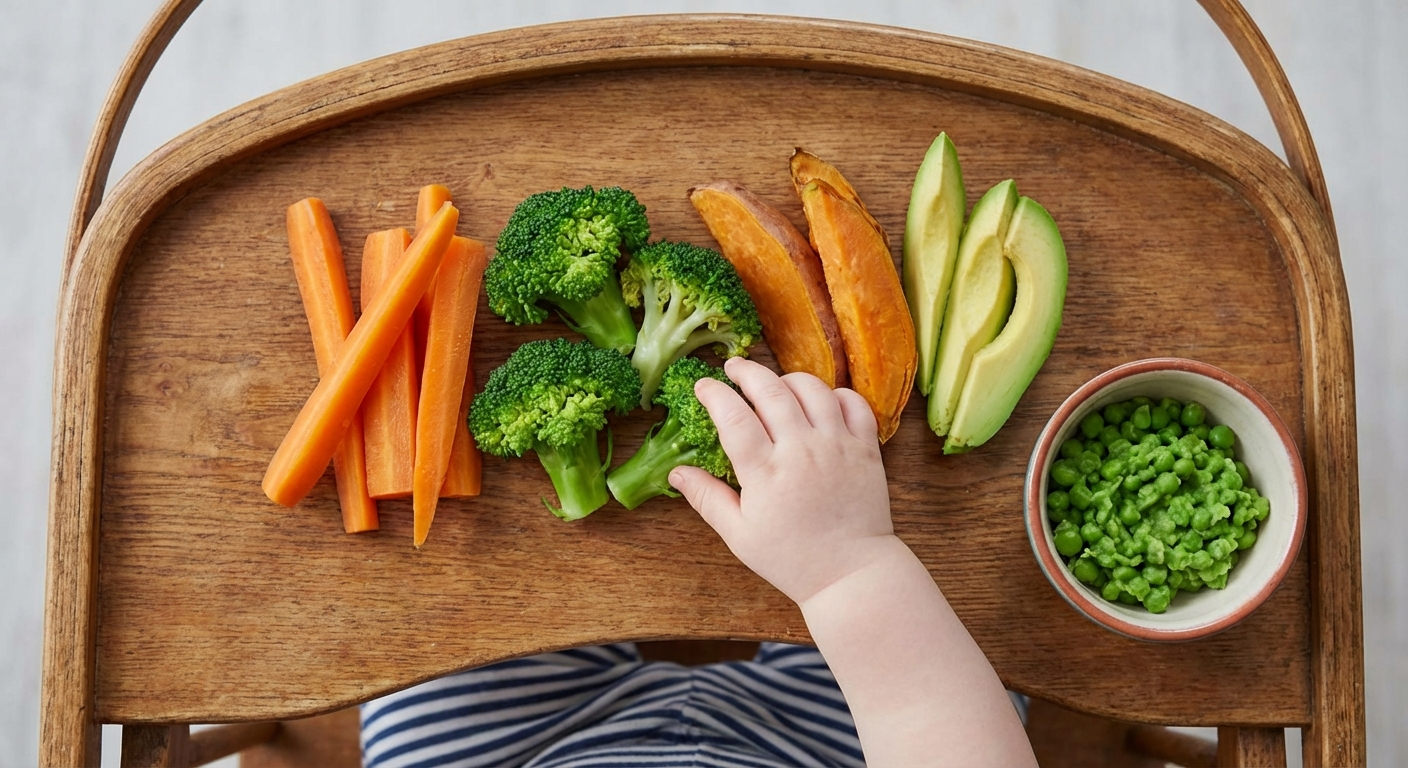
Table of Contents
- What Is Baby-Led Weaning?
- BLW vs Traditional Puree Feeding
- Is Your Baby Ready? Signs of Readiness
- Best First Foods for Baby-Led Weaning
- Foods to Avoid in the First Year
- Safety Checklist: Choking Prevention
- Essential Equipment for Baby-Led Weaning
- Week-by-Week BLW Meal Plan (6--12 Months)
- Frequently Asked Questions
- Sources & References
What Is Baby-Led Weaning?
Baby-led weaning is an approach to starting solids that puts your baby in charge of their own eating experience. Instead of spoon-feeding purees, you offer soft, graspable pieces of food and let your baby explore textures, tastes, and self-feeding from the very beginning. The term was popularised by Gill Rapley, a former health visitor and midwife, in her landmark 2008 book, and has since gained substantial backing from paediatric nutrition research worldwide.
The core philosophy is simple: babies are developmentally capable of feeding themselves when they show the accepted signs of readiness, typically around six months of age. Rather than progressing through staged purees, your baby joins family mealtimes and eats the same foods as everyone else, with minor modifications for safety and texture.
Key Principles of BLW
- Baby controls the pace. You decide what to offer; your baby decides how much to eat.
- Food is offered, not forced. There is no airplane spoon or coaxing. The baby picks up food and brings it to their mouth independently.
- Family meals are shared. Babies eat alongside the rest of the family, learning by observation and participation.
- Texture exploration is encouraged. Exposure to a variety of textures from the start may reduce picky eating later in life.
Many parents choose a combined approach, mixing some spoon-fed foods (like yoghurt or porridge) with self-fed finger foods. This is sometimes called "baby-led introduction to solids" (BLIS), and it is a perfectly valid strategy. The important thing is that the baby is an active participant in the feeding process.
BLW vs Traditional Puree Feeding
One of the most common questions new parents ask is whether baby-led weaning is better than the traditional puree approach. The truth is that both methods can produce healthy, happy eaters. However, there are meaningful differences worth understanding before you decide which path suits your family.
| Feature | Baby-Led Weaning (BLW) | Traditional Puree Feeding |
|---|---|---|
| Starting age | Around 6 months | Often introduced from 4--6 months |
| Food texture | Soft finger foods from the start | Smooth purees, gradually increasing texture |
| Who controls feeding | Baby self-feeds | Parent spoon-feeds |
| Motor skill development | Encourages pincer grasp and hand-eye coordination early | Fine motor practice comes later with finger foods |
| Mess level | High --- food exploration is part of the process | Moderate --- spoon-feeding is more contained |
| Family mealtime integration | Baby eats what the family eats (modified) | Separate meals are often prepared |
| Choking risk | Similar to purees when guidelines are followed (Fangupo et al., 2016) | Similar when age-appropriate textures are used |
| Cost | Lower --- no special baby food purchases needed | Higher if buying commercial baby food pouches |
| Time investment | Less meal prep (shared family food) | More prep for separate purees |
| Picky eating risk | Some evidence of reduced fussiness (Taylor et al., 2017) | Delayed texture introduction linked to increased fussiness |
The research is reassuring for parents on both sides. A 2016 randomised controlled trial (the BLISS study) found no significant difference in choking risk between BLW and spoon-fed babies when parents followed appropriate safety guidelines. The best approach is the one that feels right for your family, your baby's temperament, and your daily routine.
Is Your Baby Ready? Signs of Readiness
Before offering any solid food, whether purees or finger foods, your baby must show all three of the following developmental signs of readiness. These are endorsed by the World Health Organization, the American Academy of Pediatrics, and the NHS.
The Three Essential Readiness Signs
- Sitting upright with minimal support. Your baby can hold their head steady and sit in a highchair without slumping. This is critical for safe swallowing.
- Loss of the tongue-thrust reflex. When food is placed near your baby's mouth, they no longer automatically push it out with their tongue. This reflex typically fades between five and six months.
- Hand-eye-mouth coordination. Your baby can see food, pick it up, and bring it to their mouth with reasonable accuracy. They may have been practising this with toys for weeks.
Signs That Do NOT Indicate Readiness
Parents sometimes mistake certain behaviours for hunger or readiness for solids. The following are not reliable indicators on their own:
- Waking more frequently at night
- Chewing fists or putting objects in their mouth (this is normal exploratory behaviour)
- Watching you eat with interest (babies are fascinated by everything adults do)
- Being a larger-than-average baby or seeming hungrier than usual
If your baby is showing some but not all three readiness signs, it is best to wait. Most babies reach all three milestones between five and a half and seven months. There is no rush; breast milk or formula remains the primary source of nutrition throughout the first year.
Best First Foods for Baby-Led Weaning
The ideal first foods for BLW are soft enough to squish between your thumb and forefinger, large enough for your baby to grip in their fist (with some sticking out the top), and nutritionally dense. In the early weeks, babies use a palmar grasp, so food should be cut into thick strips or batons roughly the size of an adult finger.
Top 10 Starter Foods
- Steamed broccoli florets --- The natural "handle" makes them easy to grip. Steam until very soft.
- Ripe avocado strips --- Rich in healthy fats and incredibly soft. Roll in a light coating of baby cereal if too slippery.
- Banana (halved lengthwise) --- Leave a strip of peel on the bottom half for better grip.
- Steamed sweet potato batons --- High in vitamin A and naturally sweet. Cut into finger-length strips.
- Soft-cooked egg strips --- An excellent source of iron, protein, and choline. Serve as an omelette cut into strips.
- Toast fingers with nut butter --- Spread a thin layer of smooth peanut or almond butter on lightly toasted bread. Early allergen introduction is now recommended.
- Steamed carrot sticks --- Cook until they yield easily when pressed. Raw carrot is a choking hazard and must be avoided.
- Ripe mango spears --- Naturally sweet and loaded with vitamins. Choose a very ripe mango for the softest texture.
- Baked salmon flakes --- One of the best sources of omega-3 fatty acids for brain development. Remove all bones carefully and flake into large pieces.
- Iron-fortified infant oatmeal --- Can be pre-loaded onto a spoon and handed to the baby. This supports iron intake, which is crucial from six months onward.
Iron-Rich Foods: A Priority
From around six months, your baby's iron stores (built up during pregnancy) begin to deplete. Introducing iron-rich foods early is one of the most important nutritional decisions you can make. Prioritise:
- Red meat (strips of slow-cooked beef or lamb)
- Dark poultry meat (chicken thigh)
- Eggs
- Lentils and beans (mashed or served as patties)
- Iron-fortified cereals
- Tofu strips
Pairing iron-rich foods with vitamin C sources (such as steamed bell pepper strips or orange segments) enhances absorption significantly.

Foods to Avoid in the First Year
While BLW encourages broad food exploration, certain foods present a genuine safety risk or are nutritionally inappropriate for babies under twelve months.
Choking Hazards (Avoid or Modify)
- Whole grapes, cherry tomatoes, and blueberries --- Always cut lengthwise into quarters.
- Raw apple, raw carrot, and celery --- Too hard. Cook until soft or grate finely.
- Whole nuts and seeds --- Serve only as smooth butters thinly spread, never whole.
- Popcorn --- Avoid entirely until at least age four.
- Chunks of cheese --- Grate or cut into very thin strips.
- Hot dogs and sausages --- Slice lengthwise and then into small pieces if serving.
- Sticky foods like marshmallows or large globs of nut butter --- These can seal the airway.
Foods to Avoid for Health Reasons
- Honey --- Risk of infant botulism until at least twelve months.
- Added salt --- Baby kidneys cannot process excess sodium. Do not add salt to food prepared for your baby.
- Added sugar --- No nutritional benefit. Avoid sweetened foods and drinks.
- Cow's milk as a main drink --- Can be used in cooking, but should not replace breast milk or formula as a primary drink until twelve months.
- Unpasteurised dairy --- Risk of harmful bacteria.
- High-mercury fish --- Avoid shark, swordfish, king mackerel, and tilefish.
Safety Checklist: Choking Prevention
Safety is understandably the number one concern for parents considering baby-led weaning. The good news is that research consistently shows BLW does not increase the risk of choking compared to traditional feeding, provided parents follow established guidelines. Here is your comprehensive safety checklist.
Before You Start: Preparation
- Take an infant CPR and first aid course. This is the single most important step you can take. Many organisations offer free or low-cost classes both online and in person. Knowing how to respond to a choking episode gives you confidence and could save a life.
- Understand the difference between gagging and choking. Gagging is loud, involves coughing and retching, and is a normal protective reflex. Choking is silent, and the baby may turn blue or be unable to make sounds. Gagging is common and expected in BLW; choking is rare when food is prepared correctly.
- Always supervise mealtimes. Never leave your baby unattended while eating.
- Ensure your baby is sitting upright at a 90-degree angle in an appropriate highchair. Babies should never eat while reclined, lying down, or in a car seat.
During Meals: Best Practices
- Prepare food in safe shapes and textures. Soft, finger-length strips for beginners; small pieces as the pincer grasp develops (usually around eight to nine months).
- Never put food into your baby's mouth. The baby must pick up and control the food themselves. This is a fundamental safety mechanism of BLW --- if the baby can get the food to their mouth, they are developmentally ready to manage it.
- Avoid distractions during mealtimes. Turn off screens and minimise disruptions so your baby can focus on eating.
- Offer water in an open cup or straw cup alongside meals, but do not worry about quantities.
- Stay calm during gagging episodes. Resist the urge to sweep food from your baby's mouth, as this can push the food further back and turn a gag into a choke.
Know When to Seek Help
- If your baby is truly choking (silent, unable to cough, changing colour), follow your infant first aid training immediately.
- If your baby consistently refuses food after several weeks, seems distressed at mealtimes, or is losing weight, consult your paediatrician or a registered paediatric dietitian.
Essential Equipment for Baby-Led Weaning
You do not need much to get started with BLW, but a few well-chosen items will make mealtimes safer, easier, and significantly less messy. Here are the essentials.
Must-Have Items
1. A supportive highchair with a footrest A proper highchair keeps your baby seated upright at 90 degrees with feet supported --- critical for safe swallowing and good posture. Look for an adjustable model that grows with your child. Check Price on Amazon
2. Silicone suction plates and bowls Plates that stick to the highchair tray prevent your baby from flipping the entire meal onto the floor. Silicone is durable, dishwasher-safe, and free from harmful chemicals. Check Price on Amazon
3. Long-sleeved bibs or smocks BLW is messy. A full-coverage, waterproof bib with a food-catching pocket saves clothing and reduces clean-up time dramatically. Check Price on Amazon
4. Pre-loaded spoons (for runny foods) Thick, short-handled spoons designed for babies to grip themselves. Pre-load them with yoghurt, porridge, or mashed lentils and place them on the tray. Check Price on Amazon
5. Open cups and straw cups Introduce water alongside solids from six months. Small open cups (like the Tiny Cup) help develop sipping skills, and straw cups are a great alternative for practice. Check Price on Amazon
6. A splat mat or floor covering Placed beneath the highchair, a splat mat catches dropped food and makes clean-up as simple as wiping or shaking it out. Your floors will thank you. Check Price on Amazon
Nice-to-Have Items
- Crinkle cutter knife --- Creates textured, ridged strips that are easier for small hands to grip. Particularly useful for slippery foods like avocado and mango. Check Price on Amazon
- Food-catching highchair liner --- An additional layer of food protection that fits around the seat.
- Portable travel highchair --- A clip-on or fabric highchair for eating out at restaurants and visiting family.
Week-by-Week BLW Meal Plan (6--12 Months)
This plan is a flexible guide, not a rigid schedule. Your baby's appetite, mood, and developmental pace will vary. In the early weeks, the goal is exploration and exposure, not calorie intake. Breast milk or formula remains the primary nutrition source throughout.
Weeks 1--2: Introduction (Around 6 Months)
Goal: Offer one meal per day, usually lunch or mid-morning when your baby is alert but not overtired or starving.
| Day | Food Offered |
|---|---|
| Day 1 | Steamed broccoli floret |
| Day 2 | Ripe avocado strip |
| Day 3 | Banana (halved lengthwise) |
| Day 4 | Steamed sweet potato baton |
| Day 5 | Soft omelette strip |
| Day 6 | Toast finger with thin peanut butter |
| Day 7 | Steamed carrot stick |
What to expect: Most food will end up on the floor, in the hair, and smeared across the tray. Your baby may lick, squish, and explore without actually swallowing much. This is completely normal and an important part of the learning process. Gagging may occur; stay calm and let your baby work through it.
Weeks 3--4: Building Variety
Goal: Continue with one meal per day. Introduce a second food alongside the first to offer variety at each sitting.
- Offer two to three different foods per meal, including at least one iron-rich option.
- Begin introducing soft fruits such as ripe pear, peach, or mango.
- Try pre-loaded spoons with iron-fortified baby oatmeal or thick yoghurt.
- Introduce common allergens one at a time (egg, peanut, dairy, wheat, soy, fish, sesame) and wait two to three days between each new allergen.
Sample meal: Steamed broccoli floret + flaked baked salmon + ripe mango spear.
Weeks 5--8: Expanding to Two Meals
Goal: Add a second meal, typically breakfast, so your baby is eating twice daily.
- Breakfast ideas: Banana pancakes (one egg + one mashed banana, cooked in a light coating of oil), toast fingers with cream cheese, porridge pre-loaded on a spoon, soft scrambled eggs.
- Lunch ideas: Steamed vegetable sticks with hummus, shredded slow-cooked chicken, lentil patties, pasta spirals with a simple tomato sauce.
- Continue offering a wide variety of flavours and textures. Do not give up on a food after one rejection. Research suggests it can take fifteen or more exposures before a baby accepts a new food.
Weeks 9--12: Three Meals a Day
Goal: Add dinner to the routine. Your baby now joins family mealtimes for all three meals.
- Modify family meals rather than preparing separate baby food. Remove salt during cooking and set aside a portion for your baby before seasoning the rest.
- Offer more complex textures: mixed dishes, stews with soft chunks, rice, pasta, and soft bread.
- Encourage drinking water from an open cup at every meal.
Sample day at 8--9 months:
| Meal | Foods |
|---|---|
| Breakfast | Porridge fingers + sliced strawberries + natural yoghurt (pre-loaded spoon) |
| Lunch | Chicken and vegetable stew with soft chunks + bread strip for dipping |
| Dinner | Baked salmon + steamed green beans + sweet potato mash (pre-loaded spoon) |
Months 4--6 of Solids (9--12 Months): Refining Skills
By this stage, most babies have developed or are developing a pincer grasp (picking up small items between thumb and forefinger). You can now begin offering smaller pieces of food alongside larger strips.
- Introduce diced soft fruits, small pieces of cooked pasta, peas, corn kernels (squashed slightly), and small cubes of cheese.
- Offer more varied proteins: strips of tofu, well-cooked minced meat, flaked fish.
- Encourage the use of utensils. While your baby will still primarily use their hands, offering a fork and spoon and modelling their use helps build the skill over time.
- Begin to offer healthy snacks between meals if your baby seems interested: rice cakes, fruit slices, vegetable sticks with dip.
Remember: Food before one is still primarily about exploration, learning, and fun. As long as your baby is continuing to breastfeed or drink formula on demand, they are getting the nutrition they need. The variety of solid foods offered is building a foundation for a lifetime of healthy eating habits.
Frequently Asked Questions
What do I do if my baby gags during baby-led weaning?
Gagging is a normal and healthy protective reflex that prevents food from reaching the airway. During BLW, gagging is especially common in the first few weeks as your baby learns to manage solid textures. When your baby gags, stay calm, maintain eye contact, and avoid the temptation to intervene by putting your fingers in their mouth. The gag reflex in young babies is triggered much further forward on the tongue than in adults, which means it activates well before food reaches a dangerous position. Over time, as your baby gains experience, gagging will become less frequent. If gagging is accompanied by genuine distress or if you observe signs of choking (silence, inability to cough, colour change), follow your infant first aid training immediately.
Can I combine baby-led weaning with purees?
Absolutely. A combined approach is both common and well-supported. Many families offer finger foods for self-feeding alongside purees or mashed foods served on a pre-loaded spoon that the baby brings to their own mouth. This method can ease parental anxiety about nutrient intake while still giving the baby autonomy and exposure to a range of textures. The key principle to maintain is that the baby remains in control of what goes into their mouth. Even when offering purees, hand the spoon to your baby rather than feeding them directly. Research from the BLISS study (2016) specifically used this combined model and found excellent outcomes for both safety and nutrition.
How do I know if my baby is eating enough?
In the first several weeks of baby-led weaning, your baby will likely eat very little. Most of the food will be explored, tasted, and discarded. This is entirely normal. Breast milk or formula continues to provide the vast majority of calories and nutrients during the first year. Signs that your baby is getting adequate nutrition include steady weight gain along their growth curve, regular wet and dirty nappies, and general alertness and contentment. If you are concerned about your baby's intake or weight, consult your paediatrician or a registered dietitian. Tracking a food diary for a week can also help professionals assess the situation accurately.
When should I introduce common allergens?
Current guidelines from the American Academy of Pediatrics, the Australasian Society of Clinical Immunology and Allergy, and the British Society for Allergy and Clinical Immunology all recommend introducing common allergens early and regularly, starting from around six months of age. The major allergens to introduce include peanut (as smooth peanut butter thinly spread), egg, cow's milk (in cooking or as yoghurt), wheat, soy, tree nuts (as smooth butters), fish, and sesame. Introduce one new allergen at a time and wait two to three days before introducing the next, so you can identify any reaction. Once an allergen has been introduced without issue, continue to offer it regularly (at least twice per week) to maintain tolerance. The LEAP and EAT studies provided strong evidence that early introduction reduces the risk of developing food allergies.
Is baby-led weaning safe for premature babies?
Baby-led weaning can be appropriate for premature babies, but the timeline should be adjusted based on corrected age rather than actual birth date. A baby born two months premature, for example, may not be developmentally ready for solids until eight months of actual age (six months corrected). The same readiness signs apply: sitting upright with minimal support, loss of the tongue-thrust reflex, and hand-eye-mouth coordination. It is especially important for parents of premature babies to work closely with their paediatrician or neonatal team before starting solids. Some premature babies may benefit from a combined approach (purees and finger foods) to ensure adequate calorie and iron intake, as their nutritional needs can be more complex.
Sources & References
-
Rapley, G., & Murkett, T. (2008). Baby-Led Weaning: The Essential Guide to Introducing Solid Foods and Helping Your Baby to Grow Up a Happy and Confident Eater. The Experiment Publishing.
-
Taylor, R. W., Williams, S. M., Fangupo, L. J., et al. (2017). Effect of a baby-led approach to complementary feeding on infant growth and overweight: A randomized clinical trial. JAMA Pediatrics, 171(9), 838--846.
-
Fangupo, L. J., Heath, A. L. M., Williams, S. M., et al. (2016). A baby-led approach to eating solids and risk of choking. Pediatrics, 138(4), e20160772.
-
Du Toit, G., Roberts, G., Sayre, P. H., et al. (2015). Randomized trial of peanut consumption in infants at risk for peanut allergy (LEAP Study). New England Journal of Medicine, 372(9), 803--813.
-
Perkin, M. R., Logan, K., Tseng, A., et al. (2016). Randomized trial of introduction of allergenic foods in breast-fed infants (EAT Study). New England Journal of Medicine, 374(18), 1733--1743.
-
World Health Organization. (2023). Complementary feeding: Report of the global consultation. WHO Technical Report Series.
-
American Academy of Pediatrics Committee on Nutrition. (2024). Complementary feeding: Introduction of solids. In Pediatric Nutrition Handbook (8th ed.). AAP.
-
D'Auria, E., Bergamini, M., Staiano, A., et al. (2018). Baby-led weaning: What a systematic review of the literature adds on. Italian Journal of Pediatrics, 44(1), 49.
-
Daniels, L., Heath, A. L. M., Williams, S. M., et al. (2015). Baby-Led Introduction to SolidS (BLISS) study: A randomised controlled trial of a baby-led approach to complementary feeding. BMC Pediatrics, 15(1), 179.
-
Brown, A., & Lee, M. (2015). Early influences on child satiety-responsiveness: The role of weaning style. Pediatric Obesity, 10(1), 57--66.
This article was reviewed and updated in March 2026 by Dr. Lisa Park, a registered paediatric dietitian with over fifteen years of clinical experience in infant nutrition. The information provided is for educational purposes and should not replace personalised medical advice. Always consult your baby's healthcare provider before starting solids.